Climate change effects on alpine ecosystems
Webpage under construction
ACCLIMATE - Acclimation to Climate Change of Lichens in Mountain Alpine Terricolous Environments
Principal investigator: Prof. Michele Carbognani
Team: Prof. Alessandro Petraglia, Dr Andrea Vannini, Dr Elisa Beninato, Dr T’ai GW Forte
Status: In progress (2024-present)
Research theme 1: Functional responses of high-elevation lichens to climate change
Research theme 2: Plant diversity in mountain habitats along environmental gradients: a multi-taxon approach
Framework
This project, developed in collaboration with researchers from the University of Genoa ...
Principal investigator: Prof. Michele Carbognani
Team: Prof. Alessandro Petraglia, Dr Andrea Vannini, Dr Elisa Beninato, Dr T’ai GW Forte
Status: In progress (2024-present)
Research theme 1: Functional responses of high-elevation lichens to climate change
Research theme 2: Plant diversity in mountain habitats along environmental gradients: a multi-taxon approach
Framework
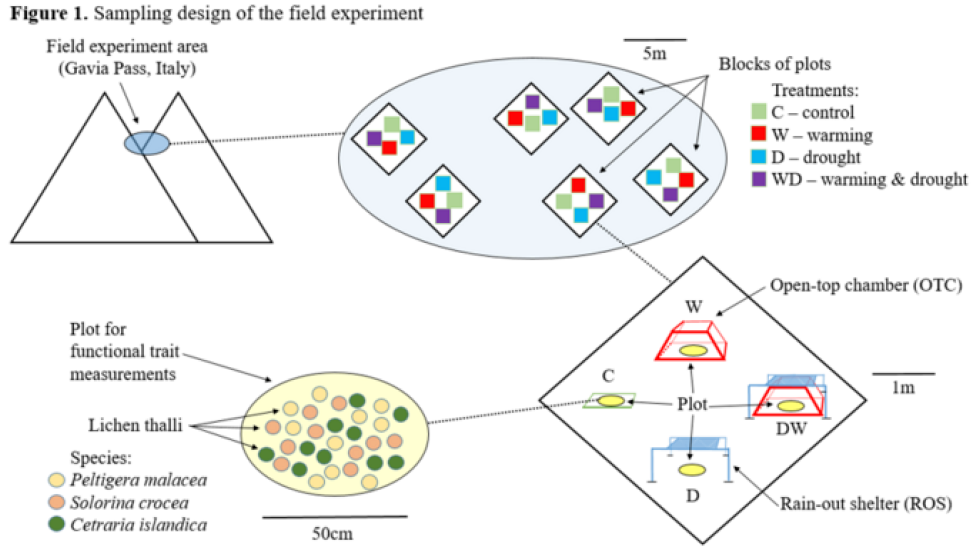
This project, developed in collaboration with researchers from the University of Genoa and Florence, aims to test the acclimation capacity of different lichen species to simulated climate change in alpine ecosystems. Lacking tissues, lichens are in constant equilibrium with water availability and atmospheric temperature and, consequently, they are particularly sensitive to environmental changes and can give anticipatory responses to observable changes in the ecosystem.
The project will test the hypothesis that, under climate change, significant differences in the acclimation response of lichen species to water shortage and warmer temperature can be observed. As proxies for the acclimation response, we will use ecophysiological traits associated with the availability of light and water, such as photosynthetic efficiency, thallus temperature and water content.
Research objectives
The ACCLIMATE project, based on climate manipulations in the field coupled with vegetation surveys along natural environmental gradients, aims to: 1) assess the responses of different lichen species to reduced precipitation and/or warmer temperatures; 2) test low-cost technologies for measuring ecophysiological parameters related to the acclimation capacity of lichens; 3) investigate the variation of plant diversity and the co-occurrence of species along natural precipitation and temperature gradients; and 4) develop predictive models on elevation shifts of species in alpine environments, explicitly considering their physiological acclimation capacity.
Main activities
Within this projects, the main activities will consist of: 1) setup of the field experiment (only for Theme 1); 2) data collection (ecophysiology of lichens in the manipulation experiment or vegetation surveys with a multi-taxon approach, considering the occurrence of vascular plants, bryophytes and lichens along natural gradients); 3) identification of species in the lab (only for Theme 2); and 4) analysis of the data collected.
Field work will be carried out at a high-elevation site (2700 m a.s.l.; Gavia valley, Italian Rhaetian Alps) managed by the research unit of the University of Parma (Theme 1) and in different sites in the Italian Rhaetian Alps (Theme 2) between June and September 2024.
Join us
This project is suitable for students in plant biology or related disciplines who are enthusiastic about mountain lichens and/or plant diversity.
Contacts
To apply, please send an email to Michele Carbognani (michele.carbognani@unipr.it) with a short message expressing your interest. We will contact you to invite you for an informal meeting.

RE-SHAPE UP – Rain Exclusion Sensitivity in High Altitude Plants and Ecosystems: Upscaling Perspectives
Principal investigator: Prof. Michele Carbognani
Team: Prof. Alessandro Petraglia, Dr Giorgio Chiari, Dr T’ai GW Forte
Status: In progress (2024-present)
Research theme 1: Drought timing effects on CO2 fluxes in an alpine grassland
Research theme 2: Effects of drought on plant functional traits in an alpine grassland
Framework
This project, developed in collaboration with researchers from the University of Udine, aims to detect the effects of extreme drought events, occurring at different ...
Principal investigator: Prof. Michele Carbognani
Team: Prof. Alessandro Petraglia, Dr Giorgio Chiari, Dr T’ai GW Forte
Status: In progress (2024-present)
Research theme 1: Drought timing effects on CO2 fluxes in an alpine grassland
Research theme 2: Effects of drought on plant functional traits in an alpine grassland
Framework
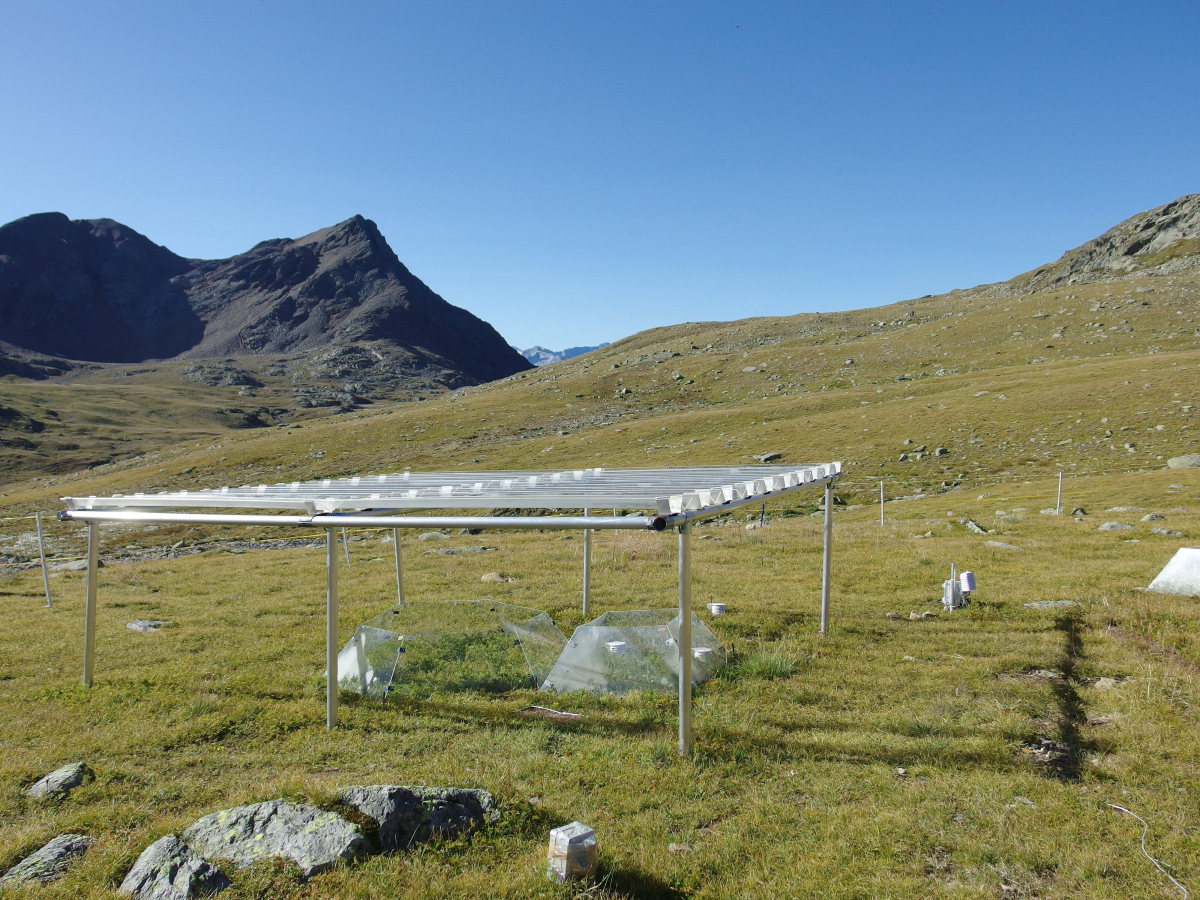
This project, developed in collaboration with researchers from the University of Udine, aims to detect the effects of extreme drought events, occurring at different perionds and lasting for one or two months, on plant functions and ecosystem processes in two alpine grassland communities. The project will follow an upscaling approach from species to community- and ecosystem-level, in order to understand the mechanisms underlying plant species, vegetation and ecosystem responses to the current climate crisis.
Research objectives
The RE-SHAPE UP project, based on experimental manipulations in the field, aims to: 1) identify the effects of extreme drought events on plant performance; 2) detect environmental thresholds for key ecosystem processes, such as biomass production and CO2 uptake and release; 3) quantify the resistance, recovery, and resilience of plant species and ecosystem functions to different timings of summer drought events; and 4) scale up the experiment results in the Alps by using remote sensing tools.
Main activities
Within this project, the main activities will consist of: 1) setup of the field experiment; 2) collection of data (CO2 fluxes for Theme 1 or plant functional traits for Theme 2); 3) sample processing in the lab; and 4) analysis of the data collected.
Field work will be carried out at a high-elevation site (2700 m a.s.l.; Gavia valley, Italian Rhaetian Alps) managed by the research unit of the University of Parma, between June and September 2024.
Join us
This project is suitable for students in ecology or related disciplines who are enthusiastic about alpine plants and/or plant-environment relationships.
Contacts
To apply, please send an email to Michele Carbognani (michele.carbognani@unipr.it) with a short message expressing your interest. We will contact you to invite you for an informal meeting.
Effects of summer warming and reduced precipitation on ecosystem functions in an alpine primary grassland
Responsible: Prof. Alessandro Petraglia, Prof. Michele Carbognani
Team: Dr. Andrea Vannini, Dr. Giorgio Chiari, Dr.ssa T’ai GW Forte
Status: In progress (2018-presente)
...Responsible: Prof. Alessandro Petraglia, Prof. Michele Carbognani
Team: Dr. Andrea Vannini, Dr. Giorgio Chiari, Dr.ssa T’ai GW Forte
Status: In progress (2018-presente)

Long-term direct and indirect effects of summer warming on alpine snowbed plant communities
Responsible: Prof. Alessandro Petraglia, Prof. Michele Carbognani
Team: Dr. Giorgio Chiari, Dr.ssa T’ai GW Forte
Status: In progress (2008/2012-present)
Research Line 1: Effects of summer warming on alpine snow-valley communities
Research Line 2: Effects of summer warming and early snowmelt on Alpine snow valleys
...Responsible: Prof. Alessandro Petraglia, Prof. Michele Carbognani
Team: Dr. Giorgio Chiari, Dr.ssa T’ai GW Forte
Status: In progress (2008/2012-present)
Research Line 1: Effects of summer warming on alpine snow-valley communities
Research Line 2: Effects of summer warming and early snowmelt on Alpine snow valleys